
Battle Ropes: Why This Full-Body Tool Earns a Spot in Your Workout

Walk through almost any gym today, and you'll find a pair of thick, heavy ropes anchored to a wall or a kettlebell. Battle ropes have gone from a strongman curiosity to a staple, and for good reason. They deliver a genuine full-body workout, spike your heart rate within minutes, and ask very little of your joints.
If you've walked past ours without picking them up, this one's for you. Here's what battle ropes actually do, what the research says about the results, and how to put them to work in your next session.
What Battle Ropes Are (and Why They Caught On)
A battle rope is a long, heavy rope, usually 30 to 50 feet, folded in half and anchored at its midpoint. You hold one end in each hand and drive waves, slams, and circles down the length of it. Because the rope resists your effort continuously, there's no coasting phase the way there is at the top of a squat or a bench press. You're working every second the rope is moving.
That continuous demand is what makes the ropes so effective, and it's why they suit almost everyone. Beginners can keep the waves small and steady; advanced lifters can turn a two-minute set into one of the hardest things they do all week. Same tool, wildly different intensities.
The Case for Battle Ropes
The gym-floor pitch for battle ropes usually comes down to five things: they burn calories, hammer the upper body, build coordination, go easy on the joints, and they're genuinely fun. Here's how each of those holds up against the evidence.
1. They Burn Calories at a Vigorous Clip
Battle ropes are demanding, and the research backs that up. In a 2015 study published in the
Journal of Strength and Conditioning Research, Fountaine and Schmidt put participants through a 10-minute rope protocol of 15 seconds of waves followed by 45 seconds of rest. Average heart rate reached 163 beats per minute, roughly 86% of age-predicted maximum, with peak intensity around 10 METs. By the American College of Sports Medicine's standards, that firmly qualifies as vigorous-intensity exercise.
Separate ACE-sponsored research out of the University of Wisconsin–La Crosse measured energy expenditure at about 10 calories per minute during battle rope intervals. The honest caveat: total calories scale with the length of your training. A short circuit won't torch four figures. But minute for minute, few tools push your heart rate and effort as high as the ropes, making them an efficient finisher when your time is short.
2. They Light Up the Upper Body and Core
If your shoulders feel like they're on fire after a set of waves, that's the intended effect. ACE-sponsored EMG research measured muscle activation in eight muscles during five rope exercises, comparing each against the 40% threshold of maximum voluntary contraction, generally considered necessary to build strength. The anterior deltoids, upper trapezius, and forearm muscles fired above that threshold consistently across variations. In the larger double-arm movements, the core muscles, including the obliques and the erector spinae, also crossed it.
In plain terms, battle ropes aren't only cardio with handles. Depending on the movement, your shoulders, forearms, chest, and midsection all get a real training stimulus. That said, they build muscular endurance more than raw size, so pair them with your heavier lifts rather than expecting them to replace those lifts.
3. They Sharpen Coordination and Core Stability
Keeping the ropes moving in rhythm, whether the two sides travel together or in opposition, is as much a coordination task as a conditioning one. Your core works constantly to keep your torso stable while your arms do the driving. Over time, that carries over to better balance, posture, and control, both under the barbell and in everyday movement like carrying, lifting, and reaching.
4. They Go Easy on Your Joints
Here's an underrated benefit: battle ropes deliver high metabolic demand with very little impact. There's no pounding through your knees the way there is with running or jumping, and no maximal load compressing your spine the way there is with heavy lifting. That combination of high effort and low joint stress makes the ropes a smart conditioning option on recovery days, during a return from a lower-body niggle, or for anyone whose joints don't love repeated impact.
5. They’re Genuinely Fun
This one has no citation, and it doesn't need one. Battle ropes are among the most satisfying things in the gym to use. That matters more than it sounds because the workout you actually look forward to is the one you'll keep coming back to.
What Muscles Do Battle Ropes Work?
The exact mix depends on the movement, but a typical rope session recruits:
- Shoulders (deltoids) — the prime movers on nearly every wave and slam.
- Forearms and grip — working overtime to hold on and control the rope.
- Core (abdominals and obliques) — stabilizing your torso and, in slams, driving the movement.
- Upper back and traps — supporting the shoulders through every rep.
- Chest — engaged on many pressing and slamming patterns.
- Legs and glutes — bracing the base, and doing real work when you add squats or lunges to the movement.
The double-arm slam deserves a special mention. In the ACE research, it registered as one of the most intense exercises tested, both for calorie burn and for how many muscles it drove above the strength-building threshold. If you want the most from a short set, that's where to start.
How to Program Battle Ropes
The ropes are versatile, but they shine brightest in short, hard intervals. A few coaching notes:
Mind your work-to-rest ratio. How you structure rest changes the metabolic cost more than most people realize. Ratamess and colleagues (902) 482-9362 compared shorter and longer rest periods during rope exercise and found the shorter-rest protocol produced significantly higher energy expenditure. If calorie burn and conditioning are the goal, keep rest tight. If you're focused on producing sharp, powerful waves, give yourself a little more recovery, so quality doesn't fade.
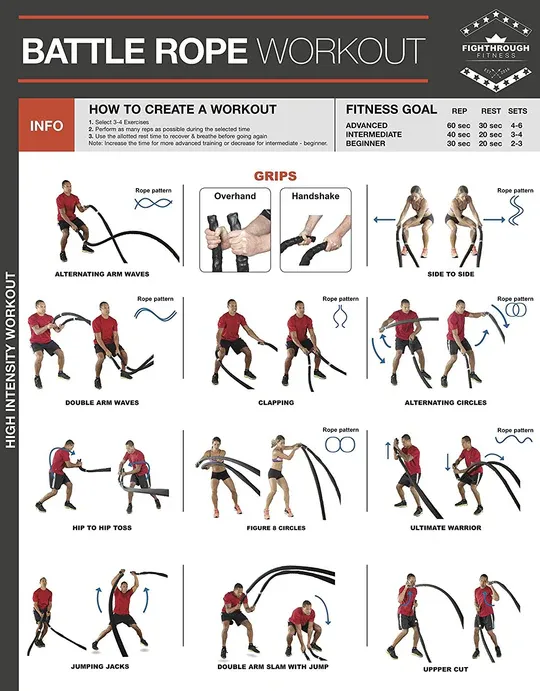
Start with the staples. Three movements will carry you a long way: the alternating wave (arms moving out of sync), the double-arm wave (both arms together), and the double-arm slam (lift the rope overhead and drive it into the floor). Master those before chasing the fancier variations.
Chase amplitude, not just speed. As you fatigue, the waves naturally shrink. Fight that. Keeping the waves tall and consistent is what keeps the muscles working and the intensity high.
Coach's tip: You'll find our battle ropes in the TRX/Spin zone, along with an exercise sheet posted on the wall. Every time you train in that area, try a movement you haven't done before.
A Finisher to Try
When you want to end a session with something that leaves a mark, run this one:
- 12 TRX high rows
- 15 TRX jump squats, or plyo lunges (each side)
- 45-second sprint on the spin bike
- 30 seconds of alternating waves on the battle ropes
Complete 4 rounds for time, resting as needed. It blends pulling, plyometrics, and two conditioning tools into a few brutal minutes, and the ropes at the end make sure you finish with nothing left in the tank.
The Bottom Line
Battle ropes are one of the rare tools that check almost every box at once. They raise your heart rate into vigorous territory in minutes, train your shoulders, arms, and core through real muscle activation, build coordination and stability, and do all of it without hammering your joints. Whether you use them as a standalone conditioning block or as the finisher that empties the tank, they earn their place in your program.
Next time you're in the TRX/Spin zone, grab the ropes and give a new movement a try. If you'd like a coach to walk you through proper technique or build the ropes into a program that fits your goals, our team at Purdy's Wellness and Fitness Club is always happy to help.
References
- Fountaine, C.J., & Schmidt, B.J. Metabolic cost of rope training. Journal of Strength and Conditioning Research, 29(4).
- Ratamess, N.A., Smith, C.R., Beller, N.A., et al. Effects of rest interval length on acute battling rope exercise metabolism. Journal of Strength and Conditioning Research, 29(9).
- American Council on Exercise (ACE)-sponsored research, University of Wisconsin–La Crosse. The relative intensity and energy expenditure of battle rope exercise; and muscle activation during battle rope exercises.
Grab the Rope. Feel the Burn!
You've seen what the ropes can do: vigorous intensity in minutes, a real full-body stimulus, and all of it easy on your joints. Book a session and let one of our coaches put them to work for you, dialling in your technique and building the ropes into a program that fits your goals. Or, simply grab them in the TRX/Spin zone and finish your next workout with nothing left in the tank.
Recent Posts